
When we talk about learning to read, we often focus on phonemic awareness, phonics, and decoding. These skills are essential. Students must be able to hear sounds in words, connect those sounds to letters, and read words accurately. But word reading is only one side of the reading process.
To become skilled readers, students also need strong language comprehension.
Language comprehension includes vocabulary, background knowledge, sentence structure, verbal reasoning, listening comprehension, and the ability to understand stories, explanations, and academic conversations. In simple terms, students cannot fully understand what they read if they do not understand the language behind the print.
Why Language Development Matters
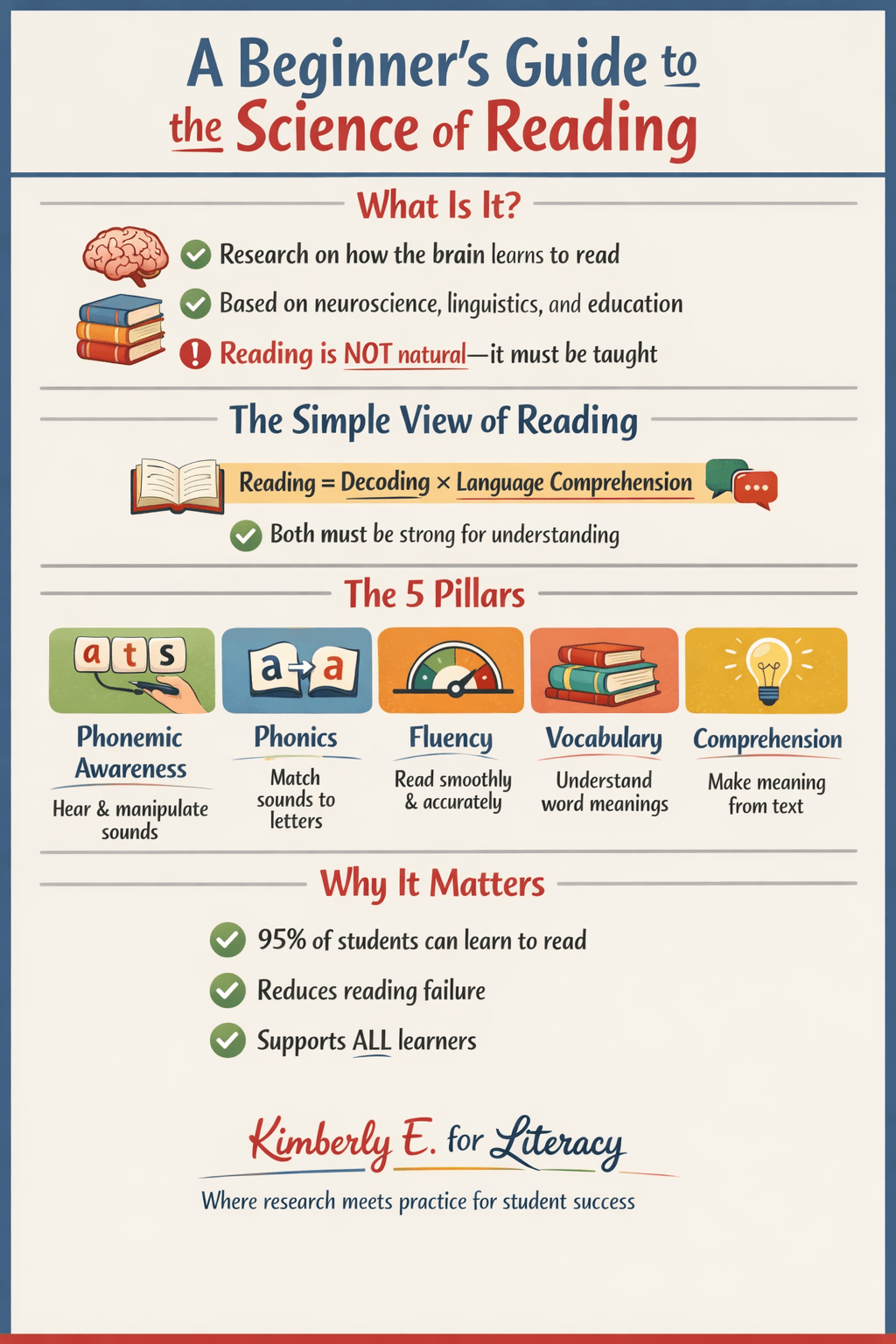
The Simple View of Reading explains reading comprehension as the product of two major parts: word recognition and language comprehension. A student may decode every word on the page, but if the vocabulary, sentence structure, or background knowledge is weak, comprehension will still break down.
Scarborough’s Reading Rope gives us another helpful visual. Skilled reading develops when word recognition strands and language comprehension strands become increasingly automatic and strategic. This means early literacy instruction cannot be only phonics instruction. It must also intentionally build oral language, vocabulary, knowledge, and comprehension.
In the famous “Baseball Study,” researchers Donna Recht and Lauren Leslie found that struggling readers with strong background knowledge about baseball often comprehended a baseball passage better than proficient readers who lacked baseball knowledge. The study demonstrated that comprehension depends not only on the ability to read words but also on the knowledge and language students bring to the text (Recht & Leslie, 1988).
How Language Impacts Phonemic Awareness and Decoding
Phonemic awareness is an oral language skill. Before children can map sounds to letters, they must be able to hear and manipulate the sounds in spoken words. Students with weak oral language may struggle to notice sound patterns, segment words, blend sounds, or connect spoken language to print.
Language also supports decoding because students use their knowledge of words to confirm what they read. For example, a child decoding the word “habitat” is more likely to read it accurately and understand it if the word is already part of their oral vocabulary. Vocabulary and background knowledge help students make meaning from the words they decode.
What Should We Do in Early Childhood?
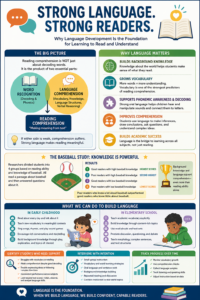
In early childhood, language development should be a daily instructional priority. Children need rich conversations, interactive read-alouds, songs, rhymes, storytelling, and repeated exposure to new words and ideas.
Early childhood classrooms should include:
- Daily read-alouds with discussion
- Explicit vocabulary teaching
- Opportunities for children to answer “why” and “how” questions
- Songs, rhymes, syllable games, and sound play
- Story retelling with pictures, props, and oral rehearsal
- Background knowledge building through science, social studies, art, and play
- Teacher modeling of complete sentences and expanded language
The goal is not simply to prepare children to “sound out words.” The goal is to build the language system they will use to understand those words once they are printed on a page.
What Should We Do in Elementary School?
In elementary school, students still need explicit, systematic instruction in phonemic awareness, phonics, decoding, spelling, and fluency. But they also need intentional instruction in language comprehension.
Elementary classrooms should include:
- Knowledge-building read-alouds and text sets
- Explicit vocabulary instruction
- Morphology instruction, including prefixes, suffixes, and roots
- Sentence-level work with complex syntax
- Oral discussion before writing
- Comprehension strategy instruction
- Frequent opportunities to summarize, retell, explain, compare, and infer
- Content-rich instruction in science, social studies, and the arts
A strong literacy block should not separate “learning to read” from “learning about the world.” Students need both.
How Do We Identify Gifted Students Who Need Language Support?
Gifted students can also have language development needs. Some gifted learners have strong reasoning skills but weaker oral language, vocabulary depth, listening comprehension, written expression, or reading comprehension. These students may be twice-exceptional, meaning they show advanced ability in one area while also needing support in another.
These students can be difficult to identify because their strengths may mask their needs. A gifted student may use intelligence, memory, or problem-solving to compensate for language weaknesses. They may read words accurately but struggle to explain ideas, infer meaning, organize thoughts, follow complex oral directions, or comprehend dense text.
Warning signs may include:
-
- Strong verbal opinions but weak organized explanations
- High reasoning ability but poor written responses
- Accurate decoding but weak comprehension
- Difficulty retelling or summarizing
- Trouble with academic vocabulary
- Weak listening comprehension
- Avoidance of reading or writing tasks
- Inconsistent performance across subjects
- Frustration, perfectionism, or behavior concerns during language-heavy tasks
Giftedness should never prevent a student from receiving support. Advanced thinking and language weaknesses can exist at the same time.
How Can We Intervene?
Language intervention should be explicit, intentional, and connected to classroom reading and writing. Students need more than exposure. They need direct teaching, modeling, practice, and feedback.
Effective interventions may include:
-
- Small-group vocabulary instruction
- Oral sentence expansion
- Story grammar and retelling routines
- Listening comprehension practice
- Background knowledge building before reading
- Morphology instruction
- Structured academic conversation
- Visual supports and graphic organizers
- Repeated read-alouds with targeted questioning
- Sentence frames that help students explain, compare, infer, and justify
For students who also struggle with decoding, intervention must address both sides of reading: word recognition and language comprehension. We should not wait until decoding is perfect to build comprehension.
How Can We Track Progress?
Progress monitoring for language development should include more than a single comprehension score. Teachers can track specific language behaviors over time.
Helpful measures include:
- Vocabulary checks for taught words
- Oral retell rubrics
- Listening comprehension questions
- Sentence repetition or sentence expansion tasks
- Student explanations using academic vocabulary
- Written response samples
- Story grammar checklists
- Curriculum-based comprehension checks
- Language samples during discussion
- Reading comprehension performance after background knowledge and vocabulary support
A simple progress-monitoring routine might include a baseline language sample, targeted intervention for 4–6 weeks, and repeated checks using the same type of task. The key question is: Can the student understand, use, and explain language more effectively over time?
Final Takeaway
Reading is not just sounding out words. Reading is making meaning from language through print.
If we want students to become strong readers, we must teach the code and build the language. Phonemic awareness and decoding help students access the words. Vocabulary, background knowledge, syntax, and oral language help students understand what those words mean.
Strong readers need both.
References
Adlof, S. M. (2019). Measuring language development to inform literacy instruction. Language, Speech, and Hearing Services in Schools, 50(3), 363–377.
Gough, P. B., & Tunmer, W. E. (1986). Decoding, reading, and reading disability. Remedial and Special Education, 7(1), 6–10.
Hogan, T. P., Adlof, S. M., & Alonzo, C. N. (2014). On the importance of listening comprehension. International Journal of Speech-Language Pathology, 16(3), 199–207.
National Early Literacy Panel. (2008). Developing early literacy: Report of the National Early Literacy Panel. National Institute for Literacy.
National Institute of Child Health and Human Development. (2000). Report of the National Reading Panel: Teaching children to read.
Recht, D. R., & Leslie, L. (1988). Effect of prior knowledge on good and poor readers’ memory of text. Journal of Educational Psychology, 80(1), 16–20. https://doi.org/10.1037/0022-0663.80.1.16
Scarborough, H. S. (2001). Connecting early language and literacy to later reading disabilities. In S. Neuman & D. Dickinson (Eds.), Handbook of early literacy research (pp. 97–110). Guilford Press.
What Works Clearinghouse. (2016). Foundational skills to support reading for understanding in kindergarten through 3rd grade. Institute of Education Sciences.