
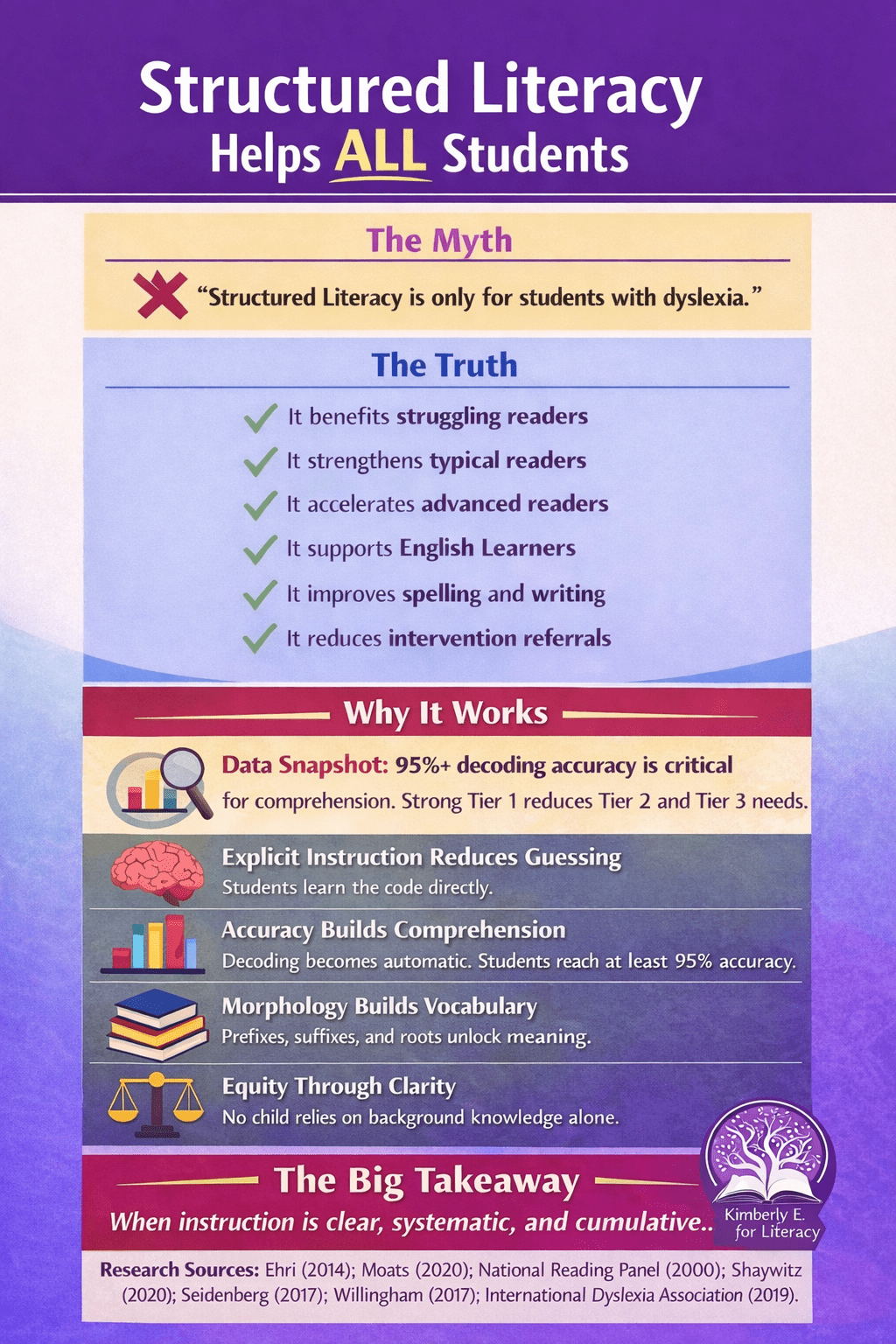
Not just struggling readers. Not just students with dyslexia. Every single child.
In recent years, Structured Literacy has become strongly associated with dyslexia intervention. While it is essential for students with reading disabilities, one of the biggest misconceptions in education is this:
Structured Literacy is only for struggling readers.
The truth?

Structured Literacy benefits every learner in your classroom.
Let’s break down why.
What Is Structured Literacy?
Structured Literacy is an explicit, systematic, cumulative approach to teaching reading and spelling. It directly teaches:
- Phonemic awareness
- Sound-symbol correspondence
- Syllable types
- Morphology (prefixes, suffixes, roots)
- Syntax
- Semantics
It follows a clear scope and sequence and ensures students master foundational skills before moving forward.
Unlike “incidental” or discovery-based approaches, Structured Literacy does not assume children will naturally infer the code of English.
It teaches the code clearly.
It Supports Students With Dyslexia (But That’s Just the Beginning)
Students with dyslexia require explicit instruction in phonological processing and decoding. Structured Literacy is:
- Direct
- Systematic
- Diagnostic
- Responsive
For these learners, it is not optional — it is essential.
But here’s what’s important:
The same instructional clarity that benefits dyslexic students strengthens learning for everyone else.
It Reduces Cognitive Load for All Learners
When phonics patterns are taught explicitly and practiced to mastery:
- Students decode more automatically.
- Working memory is freed.
- Cognitive resources shift toward comprehension.
Instead of guessing at words, students read with accuracy (95%+), which research shows is the threshold necessary for strong comprehension.
When decoding is automatic, meaning becomes the focus.
That benefits:
- Advanced readers
- English Learners
- Students with language weaknesses
- Students with attention challenges
- Gifted students
It Creates Equity Through Clarity
Some children arrive at school already knowing parts of the code because of:
- Rich literacy environments
- Parent/Preschool instruction
- Early exposure to books
Other students do not.
If phonics is implied rather than explicitly taught, gaps widen.
Structured Literacy ensures:
- No student relies on guesswork
- No child is left to “figure it out”
- Access to grade-level text becomes attainable for all
Explicit instruction is not “remedial.”
It is equitable.
It Strengthens Spelling and Writing
Reading and spelling develop together.
When students understand:
- Why hope drops the “e” in hoping
- Why magic becomes magician
- Why cats and dogs use different plural endings
They write with confidence.
Morphology (meaning) instruction in Structured Literacy improves:
- Vocabulary
- Writing sophistication
- Content-area comprehension
This is especially powerful in grades 3–5 when academic language increases.
It Benefits English Learners
English Learners thrive when language patterns are made visible.
Structured Literacy:
- Makes sound patterns explicit
- Clarifies spelling conventions
- Breaks complex words into meaningful parts
For multilingual students, this clarity reduces confusion and accelerates growth.
Structured Literacy Is Especially Powerful for English Learners because…
- English Learners do not just need exposure to language. They need patterns made visible. Structured Literacy provides:
- Explicit Sound Instruction
- English has 44+ phonemes, many of which are not present in other languages.
- Direct modeling reduces confusion.
- Clear Spelling Patterns – Instead of memorizing words, students learn:
- When to use C vs K
- Why silent e changes vowel sounds
- Why -ed has three sounds
- Morphology Instruction – Academic vocabulary becomes accessible when students learn:
- Prefixes (re-, un-, dis-)
- Suffixes (-tion, -ment, -able)
- Latin and Greek roots
- This is critical in all grades, but particularly valuable in 3–5, so students can unpack word meanings.
- Reduced Guessing -English Learners often rely on context clues.
- Structured Literacy ensures decoding accuracy first.
- Accuracy → Fluency → Comprehension
- Creates Confidence Through Clarity – Clear patterns reduce anxiety and increase participation.
- When language structures are made explicit, English Learners thrive.
- Structured Literacy is not just a reading strategy, it is language equity in action.
It Improves Tier 1 Core Instruction
In an MTSS framework, the strongest intervention is prevention.

When Tier 1 instruction is:
- Explicit
- Systematic
- Data-informed
- Aligned to the science of reading
Fewer students require Tier 2 and Tier 3 intervention.
Strong core reduces remediation needs.
REMEMBER: YOU WILL NEVER INTERVENE YOUR WAY OUT OF A CORE PROBLEM!!!
What Happens When We Don’t Use Structured Literacy?
Students may:
- Guess at words using pictures
- Memorize instead of decode
- Struggle silently
- Develop reading anxiety
- Plateau in upper elementary grades
Often, comprehension issues in grades 3–5 are decoding gaps in disguise.
Structured Literacy Is Not a Program — It’s a Framework
It can be implemented through many programs, including:
- Fundations
- UFLI
- Barton
- SPIRE
- SLANT Reading System
The key is not the brand – it’s the instructional design.
The Bottom Line
Structured Literacy:
 Supports students with dyslexia
Strengthens typical readers
Accelerates advanced readers
Supports English Learners
Builds spelling and writing
Improves Tier 1 outcomes
Promotes equity
It is not a special education strategy.
It is high-quality instruction.
Final Thought
When we design instruction for the students who need it most, we improve learning for everyone.
That is the heart of Structured Literacy.
Research Supporting Structured Literacy
Decades of research demonstrate that explicit, systematic instruction in phonemic awareness, phonics, fluency, vocabulary, and comprehension significantly improves reading outcomes for students (National Reading Panel, 2000). Structured literacy approaches align with cognitive science research on how the brain learns to read and are particularly effective for students with dyslexia and other reading difficulties (Moats, 2020; Shaywitz, 2020; Ehri, 2014).
References:
Foundational Reading Science
National Reading Panel (2000).
Teaching children to read: An evidence-based assessment of the scientific research literature on reading and its implications for reading instruction (NIH Publication No. 00-4769). National Institute of Child Health and Human Development.
Science of Reading / Reading Development
Mark S. Seidenberg (2017).
Language at the speed of sight: How we read, why so many can’t, and what can be done about it. Basic Books.
Dyslexia and Structured Literacy
Sally E. Shaywitz (2020).
Overcoming dyslexia (2nd ed.). Alfred A. Knopf.
Structured Literacy Definition
International Dyslexia Association. (2019).
Structured literacy: Effective instruction for students with dyslexia and related reading difficulties. International Dyslexia Association.
Language and Reading Development
Louisa C. Moats (2020).
Speech to print: Language essentials for teachers (3rd ed.). Brookes Publishing.
Cognitive Science of Reading
Daniel T. Willingham (2017).
The reading mind: A cognitive approach to understanding how the mind reads. Jossey-Bass.
Orthographic Mapping & Decoding
Linnea C. Ehri (2014).
Orthographic mapping in the acquisition of sight word reading, spelling memory, and vocabulary learning. Scientific Studies of Reading, 18(1), 5–21.
Fluency and Accuracy Thresholds
Timothy Rasinski (2012).
Why reading fluency should be hot. The Reading Teacher, 65(8), 516–522.
Affiliate Disclaimer:
This post contains affiliate links. As an Amazon Associate, I earn from qualifying purchases.