
Kimberly E for Literacy: Where research meets practice for student success.
If you’ve heard the term Science of Reading but aren’t quite sure what it means—or how it applies to your classroom—you’re not alone.
Let’s break it down in a clear, practical way so you can confidently apply it to your instruction.
What Is the Science of Reading?
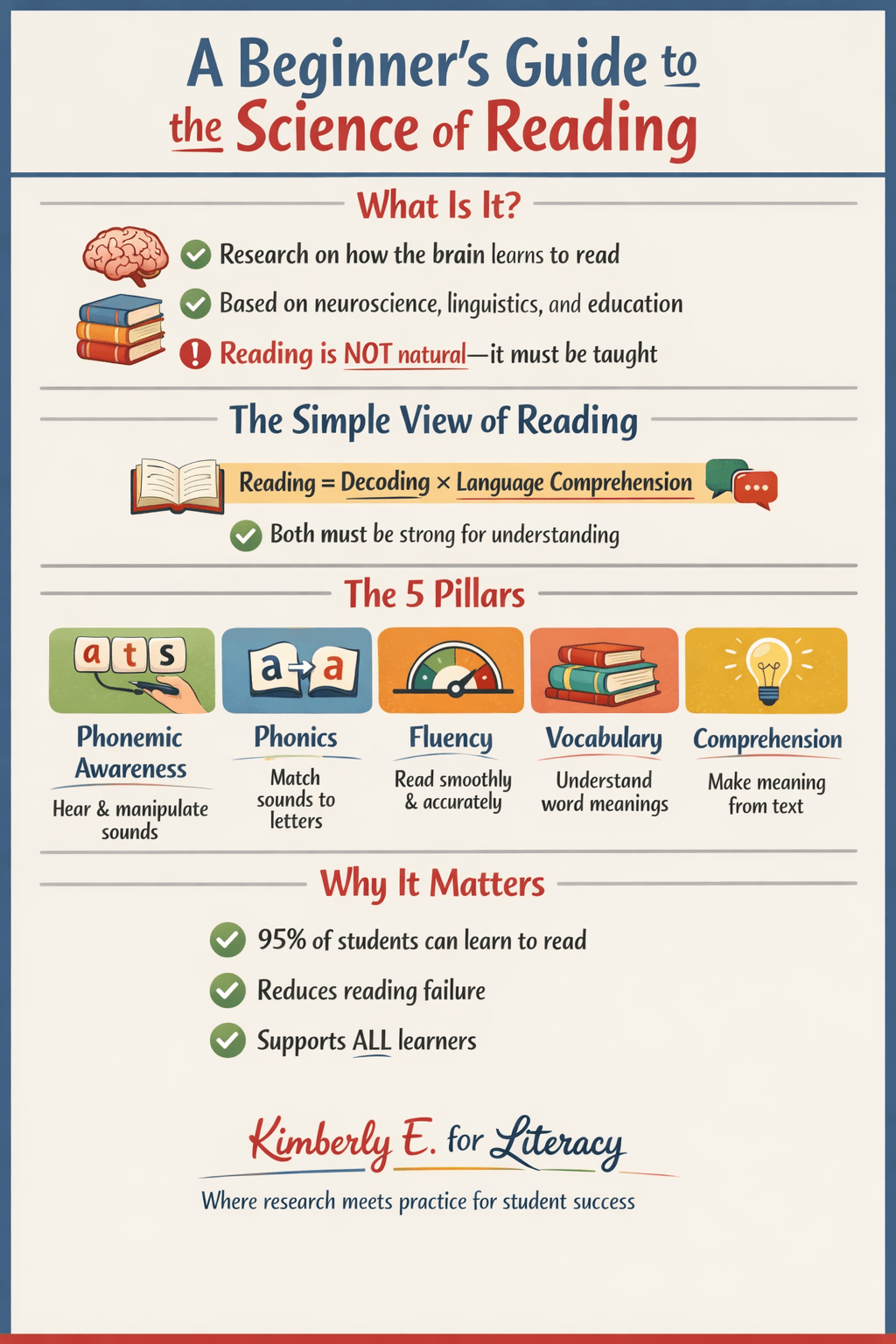
The Science of Reading (SoR) is a large body of interdisciplinary research that explains how the brain learns to read. It draws from fields such as:
- Cognitive psychology
- Neuroscience
- Linguistics
- Education research
This research consistently shows that reading is not a natural process—it must be explicitly taught.
The Simple View of Reading
One of the most important frameworks in the Science of Reading is the Simple View of Reading:
Reading Comprehension = Decoding × Language Comprehension
This means:
- If students can’t decode, they can’t access the text
- If students can’t understand language, comprehension breaks down
Both are essential—and both must be taught.
The Five Pillars of Reading Instruction
Based on research from the National Reading Panel, effective reading instruction includes five key components:
1. Phonemic Awareness
The ability to hear and manipulate individual sounds (phonemes) in spoken words.
Example skills:
- Blending sounds: /c/ /a/ /t/ → cat
- Segmenting: dog → /d/ /o/ /g/
2. Phonics
The relationship between sounds and letters.
What it looks like:
- Explicit instruction in letter-sound correspondences
- Decoding words (not guessing!)
- Encoding (spelling) words
3. Fluency
The ability to read accurately, quickly, and with expression.
Why it matters:
Fluency bridges decoding and comprehension. Students who struggle to read smoothly often struggle to understand.
4. Vocabulary
The words students know and understand.
Strong instruction includes:
- Explicit teaching of word meanings
- Morphology (prefixes, suffixes, roots)
- Rich oral language exposure
5. Comprehension
The ability to make meaning from text.
Key strategies:
- Asking and answering questions
- Summarizing
- Making inferences
- Monitoring understanding
Why the Science of Reading Matters
For decades, many classrooms relied on approaches that encouraged students to guess words using pictures or context.
Research now shows:
- Strong readers rely primarily on decoding, not guessing
- Struggling readers need explicit, systematic instruction
- Early intervention prevents long-term reading failure
In fact, studies estimate that 95% of students can learn to read proficiently with effective instruction (Moats, 2020).
What Science of Reading Instruction Looks Like in Action
In a classroom aligned to the Science of Reading, you’ll see:
 Explicit, systematic phonics instruction
Daily phonemic awareness practice (especially K–1)
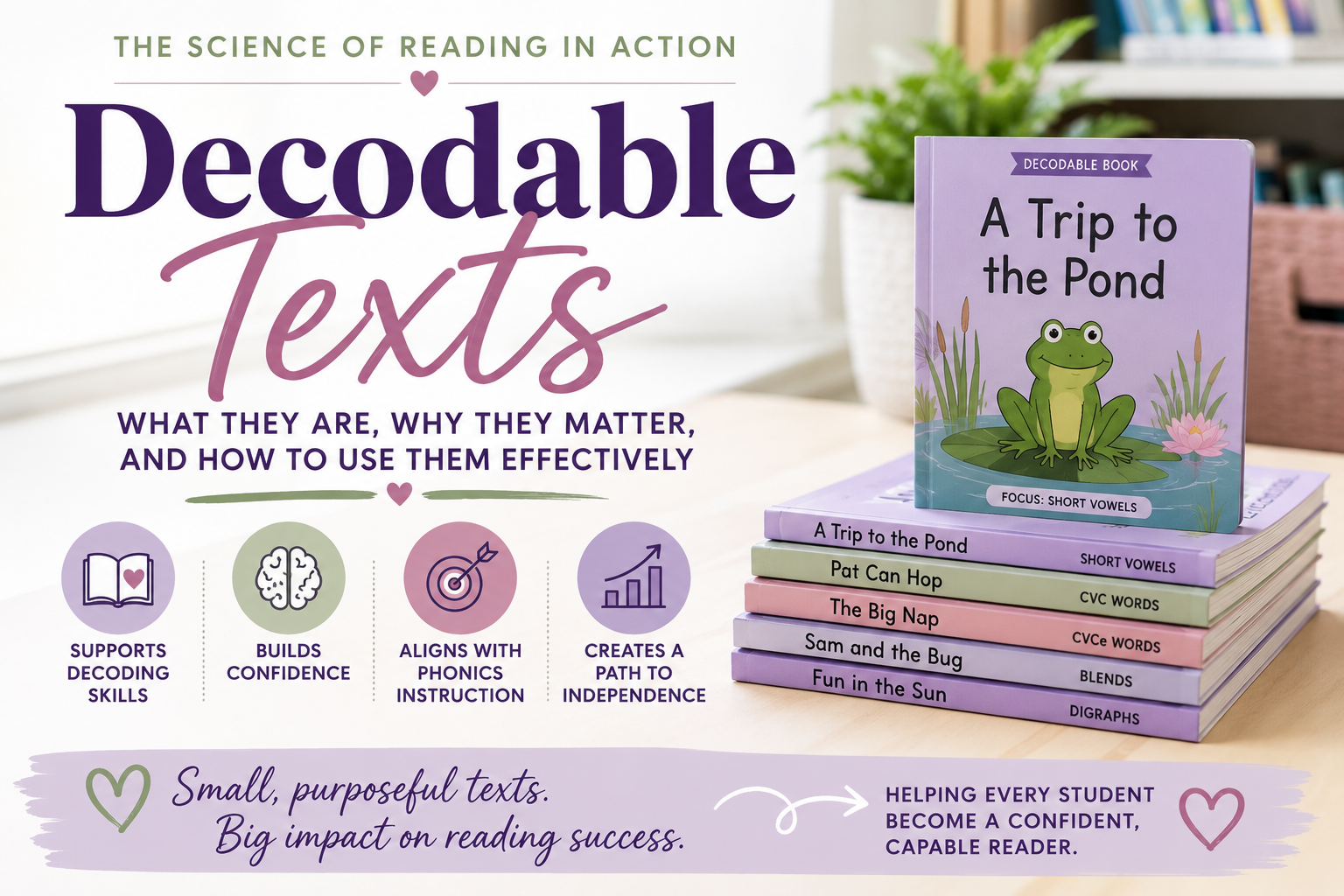
Decodable texts for early readers
Data-driven small groups (MTSS aligned)
Integrated writing and spelling instruction
Purposeful vocabulary and language development
Common Misconceptions
Let’s clear up a few myths:
 “It’s just phonics.”
 It includes language comprehension, vocabulary, and writing too.
“It only helps struggling readers.”
It benefits all students, including advanced learners and multilingual students.
“It replaces comprehension instruction.”
It strengthens comprehension by building the skills needed to access text.
Getting Started (Simple First Steps)

If you’re new to the Science of Reading, start here:
- Join your local chapter of The Reading League. These have training opportunities and chances to engage with others learning about and implementing the tenants of the Science of Reading
- Add daily phonemic awareness routines (5–10 minutes) – Heggerty, Equipped for Reading Success by David Kilpatrick, Sounds Sensible (for significant phonemic awareness deficits, MLLs), Kimberly E for Literacy Phonemic Awareness Bundle on TPT
- Use explicit phonics instruction with a clear scope & sequence, Wilson Fundations, UFLI, SPIRE, Kimberly E for Literacy Phonics Bundle and the Developmental Progression of Phonics on TPT
- Shift prompts from guessing to decoding
- Instead of: “Look at the picture”
- Try: “Look at the letters, make the sounds, blend them together. What do you notice?”
- Incorporate decodable texts for beginning readers: Bob Books Phonics Readers, Bob Books Kindergarten Beginning Readers, Pete the Cat Phonics Readers, Non-Fiction Phonics Readers 1, 2, 3, UFLI Aligned, Fundations Aligned (Geodes), Decodable Texts List from The Reading League
- Use data (FastBridge, i-Ready, DIBELS) to guide instruction
Final Thoughts
The Science of Reading isn’t a program—it’s the research behind effective instruction.
When we align our teaching with how the brain actually learns to read, we:
- Reduce frustration
- Close achievement gaps
- Empower ALL students to become confident readers
And that’s the goal.
References (APA 7th Edition)
Castles, A., Rastle, K., & Nation, K. (2018). Ending the reading wars: Reading acquisition from novice to expert. Psychological Science in the Public Interest, 19(1), 5–51. https://doi.org/10.1177/1529100618772271
Ehri, L. C. (2005). Learning to read words: Theory, findings, and issues. Scientific Studies of Reading, 9(2), 167–188. https://doi.org/10.1207/s1532799xssr0902_4
Gough, P. B., & Tunmer, W. E. (1986). Decoding, reading, and reading disability. Remedial and Special Education, 7(1), 6–10. https://doi.org/10.1177/074193258600700104
Moats, L. C. (2020). Speech to print: Language essentials for teachers (3rd ed.). Paul H. Brookes Publishing.
National Institute of Child Health and Human Development. (2000). Report of the National Reading Panel: Teaching children to read. U.S. Government Printing Office.
Scarborough, H. S. (2001). Connecting early language and literacy to later reading (dis)abilities: Evidence, theory, and practice. In S. B. Neuman & D. K. Dickinson (Eds.), Handbook of early literacy research (pp. 97–110). Guilford Press.
Seidenberg, M. S. (2017). Language at the speed of sight: How we read, why so many can’t, and what can be done about it. Basic Books.
Shaywitz, S. (2003). Overcoming dyslexia. Alfred A. Knopf.
Affiliate Disclaimer:
This post contains affiliate links. As an Amazon Associate, I earn from qualifying purchases.