
Practical, research-based strategies teachers can use tomorrow!
Phonemic awareness is one of the strongest predictors of reading success—and one of the most misunderstood.
Many educators ask:
What should phonemic awareness instruction actually look like?
How do I fit it into an already packed schedule?
The good news:
It doesn’t require complicated materials or long blocks of time.
It requires intentional, explicit, and consistent practice.

Research indicates that the most effective amount of time devoted to phonemic awareness development is:
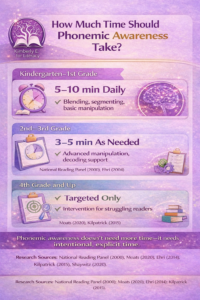
- Kindergarten – 1st Grade – Recommended: 5–10 minutes daily
- Why:
- Phonemic awareness is foundational at this stage
- Students are building sound-to-symbol connections
- Daily, brief, explicit practice is most effective
- What research shows:
- Short, focused lessons outperform long sessions
- Blending and segmenting have the strongest impact
- Instruction is most effective when paired with phonics
- Why:
- 2nd – 3rd Grade – Recommended: 3–5 minutes (as or if needed)
- Why:
- Most students should already have basic phonemic awareness
- Instruction shifts toward:
- Advanced phoneme manipulation
- Multisyllabic decoding
- Morphology
- Use phonemic awareness when:
- Students struggle with decoding or spelling
- Intervention groups need targeted support
- You notice that phonics instruction is not “sticking”
- Why:
- 4th Grade and Up – Recommended: Minimal / targeted only
- Why:
- Phonemic awareness is typically mastered
- Focus shifts to:
- Fluency
- Vocabulary
- Comprehension
- Morphology
- Exception: Students with persistent reading difficulties (e.g., dyslexia), may still require explicit phonemic awareness intervention
- Why:
What Does the Research Actually Say?
1. Instruction Should Be Brief and Explicit The National Reading Panel (2000) found:
 Phonemic awareness instruction is most effective when:
- Delivered in small, focused sessions
- Combined with phonics
- Explicitly taught (not incidental)
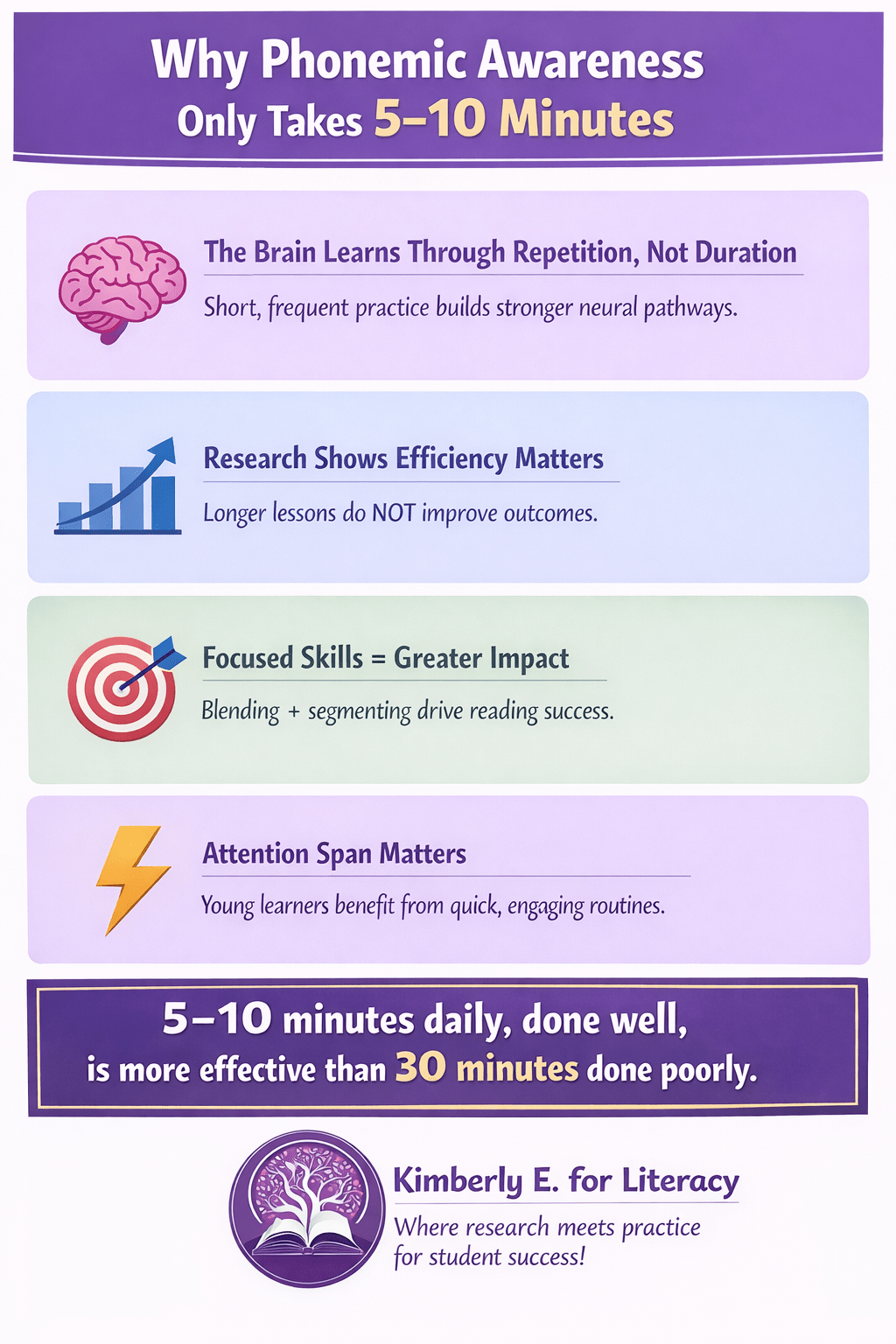
2. Over-Teaching Is NOT More Effective
Research shows:
- Longer lessons do not lead to better outcomes
- Efficiency matters more than duration
Quality Is More Important Than Quantity!
3. Daily Practice Matters More Than Time Length
Louisa C. Moats emphasizes:
- Consistent, daily exposure builds stronger neural pathways
- Instruction should be systematic and cumulative
4. Blending & Segmenting Are the Most Impactful
Linnea C. Ehri research shows:
- These skills directly support orthographic mapping
- They are more important than rhyming or onset-rime activities
5. Intervention May Require More Time
David A. Kilpatrick (2015):
- Students with reading difficulties may need:
- Increased intensity
- More repetitions
- Explicit phoneme manipulation practice
What Is Phonemic Awareness?

Phonemic awareness is the ability to hear, identify, and manipulate individual sounds (phonemes) in spoken words.
It is:
- Auditory (no print involved)
- Foundational for decoding and spelling
- A critical component of early literacy instruction
Why It Matters
Research shows that students who struggle with phonemic awareness often struggle with reading.
Strong phonemic awareness:
Improves decoding
Supports spelling
Builds reading fluency
Reduces future intervention needs
What Effective Instruction Looks Like
Phonemic awareness instruction should be:
- Explicit → Model exactly what to do
- Systematic → Follow a clear progression
- Brief → 5–10 minutes daily
- Engaging → Use movement, visuals, and oral practice
- Responsive → Adjust based on student data
10 Phonemic Awareness Activities That Actually Work

These activities are classroom-tested and align with the Science of Reading. Click the link below to visit my Teachers Pay Teacher site for my Phonemic Awareness Bundle that includes an assessment, progress monitoring, and activities that are ready to use in your classroom!
- Sound Isolation
- “What’s the first sound in map?”
- Builds awareness of individual phonemes
- Great for Kindergarten or 1st Graders who lack the ability to distinguish initial sounds.
- Sound Blending
- “What word? /c/ /a/ /t/”
- Directly supports decoding
- One of the most critical skills
- Sound Segmenting
- “Say the sounds in dog.” Student replies: /d/ /o/ /g/
- Builds spelling readiness
- Helps students map sounds to letters later
- Phoneme Deletion
- “Say smile. Now say smile without /s/.” Student replies , “mile”
- Higher-level skill
- Strong predictor of reading success
- Phoneme Substitution
- Change /m/ in mat to /s/. What’s the new word?
- Builds flexibility with sounds
- Supports word recognition
- Elkonin Boxes (Sound Boxes)
- Students push a counter for each sound they hear.
- Makes abstract sounds concrete
- Bridges to phonics instruction
- Rhyming (With Purpose)
- “Which word rhymes with cat: dog or hat?”
- Early skill—but should not be overemphasized
- Use briefly, then move to phoneme-level work
- Odd One Out
- “Which word does not belong: sun, sit, map?”
- Builds sound discrimination
- Great for small groups
- Phoneme Counting
- “How many sounds in fish?”
- Reinforces segmentation
- Builds accuracy
- Stretch and Tap
- Students stretch a word and tap each sound.
- Multisensory
- Highly effective for intervention groups
Instructional Tips That Make These Work
- Keep It Oral First – Phonemic awareness should happen without print before connecting to letters.
- Use Hand Motions and Movement – Students remember better when they:
- Tap sounds Stretch words
- Move manipulatives
- Model, Then Practice – Always follow:
- “I do → We do → You do”
- Provide Immediate Feedback – Correct errors right away:
- Model the correct response
- Have students repeat it CORRECTLY
- Start Simple, Then Increase Complexity – Progression:
- Word awareness – how many words are in a sentence
- Syllables – a word will have as many syllables as it has talking vowels
- Onset-rime break initial sound(s) from ending chunk “rime”.
- Phonemes – pull out individual sounds, such as “cat” – /c/ /a/ /t/
- What to Avoid
- Worksheets replacing oral practice
- Over-reliance on rhyming
- Skipping blending and segmenting
- Moving too quickly without mastery
How This Fits Into MTSS
Strong phonemic awareness instruction in Tier 1:
Prevents reading difficulties
Reduces intervention referrals
Supports ALL learners
For Tier 2/3:
- Increase intensity
- Add repetition
- Use smaller groups
Final Thought:
Phonemic awareness is not an “extra.” It is the foundation of reading success.
When we intentionally build these skills through daily, explicit practice, we give every student the tools they need to become confident readers.
Your Turn:
Try one new phonemic awareness activity this week.
Small shifts in instruction lead to big results.

Research Consensus Statement
Phonemic Awareness and Early Literacy
A substantial body of research across cognitive science, neuroscience, and education demonstrates that phonemic awareness is a critical foundational skill for learning to read. Phonemic awareness—the ability to identify and manipulate individual sounds in spoken words—is strongly predictive of later reading achievement and is essential for developing accurate decoding and spelling skills.
Evidence indicates that explicit, systematic instruction in phonemic awareness significantly improves students’ ability to map sounds to letters, a process known as orthographic mapping, which supports the development of automatic word recognition. Instruction that includes blending, segmenting, and phoneme manipulation has been shown to be particularly effective, especially when integrated with phonics instruction.
Research also confirms that early phonemic awareness instruction reduces the likelihood of reading difficulties and is especially beneficial for students at risk for reading failure, including those with dyslexia and multilingual learners. When implemented consistently within Tier 1 instruction, phonemic awareness instruction strengthens overall literacy outcomes and decreases the need for intensive intervention.
Collectively, the research supports the use of brief, daily, explicit phonemic awareness instruction as a key component of effective, evidence-based reading instruction aligned with the Science of Reading.
References:
Foundational Research
National Reading Panel. (2000).
Teaching children to read: An evidence-based assessment of the scientific research literature on reading and its implications for reading instruction (NIH Publication No. 00-4769). National Institute of Child Health and Human Development.
Ehri, L. C. (2004).
Teaching phonemic awareness and phonics: An explanation of the National Reading Panel meta-analyses. Reading Research Quarterly, 39(3), 342–352.
https://doi.org/10.1598/RRQ.39.3.5
Ehri, L. C. (2014).
Orthographic mapping in the acquisition of sight word reading, spelling memory, and vocabulary learning. Scientific Studies of Reading, 18(1), 5–21.
https://doi.org/10.1080/10888438.2013.819356
Cognitive Science & Reading Development
Seidenberg, M. S. (2017).
Language at the speed of sight: How we read, why so many can’t, and what can be done about it. Basic Books.
Willingham, D. T. (2017).
The reading mind: A cognitive approach to understanding how the mind reads. Jossey-Bass.
Structured Literacy & Instruction
Moats, L. C. (2020).
Speech to print: Language essentials for teachers (3rd ed.). Brookes Publishing.
International Dyslexia Association. (2019).
Structured literacy: Effective instruction for students with dyslexia and related reading difficulties.
Dyslexia & Intervention
Shaywitz, S. E. (2020).
Overcoming dyslexia (2nd ed.). Alfred A. Knopf.
Phonemic Awareness-Specific Research
Adams, M. J. (1990).
Beginning to read: Thinking and learning about print. MIT Press.
Kilpatrick, D. A. (2015).
Essentials of assessing, preventing, and overcoming reading difficulties. Wiley.
Affiliate Disclaimer:
This post contains affiliate links. As an Amazon Associate, I earn from qualifying purchases.